Bodies for Hire: The Invisible Math Behind 'He Did His Own Stunts'
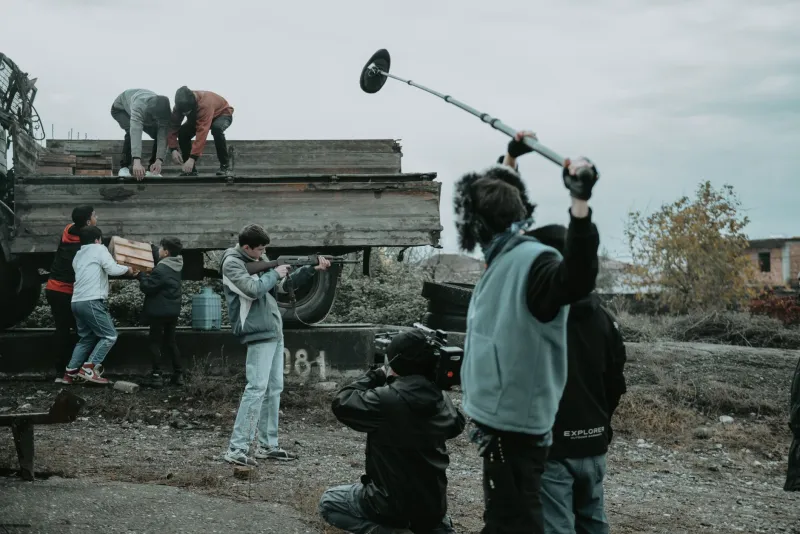
Somewhere in Los Angeles right now, a person with a gymnastics background, a motorcycle license, and a pain tolerance that would make a Navy SEAL wince is being told to fall down a flight of stairs. The star will land on the padding. The star will hit their mark. The star will, in six months, tell Jimmy Fallon that they 'did most of their own stunts, honestly.'
The person on the stairs? Their name will appear 47 minutes into the credits, between a transport captain and a craft services vendor, in a font size legally indistinguishable from a typo.
Welcome to the stunt economy — Hollywood's least glamorous multi-million dollar industry.
The Phrase That Pays (Somebody Else)
Let's decode what 'doing my own stunts' actually means, because it's less a statement of fact and more a negotiation strategy. In practice, the phrase covers a spectrum ranging from 'I genuinely performed that feat' to 'I stood near the explosion while a professional with a helmet did the dangerous part and I did the face.'
Coordinators we spoke to describe a standard split: stars typically perform the slow, close-up, controllable versions of a stunt — the reaction shot, the walk-away-from-the-explosion, the grab-the-ladder — while doubles handle anything involving actual velocity, actual height, or actual fire. One veteran coordinator put it to us in blunt terms: 'The actor does the stunt you can insure. The double does the stunt you can't.'
That's the real dividing line, by the way. Not courage. Insurance. A production will happily let its $25 million leading man dangle two feet off the ground on a rig for four hours. It will not let that same man jump off a parking structure, because if his ankle turns at the wrong angle, the entire movie becomes a write-off. The double exists as an actuarial decision wearing a wig.
The Credit Cascade
Here's where it gets truly byzantine. Stunt performer credits are negotiated in contracts the way everything in Hollywood is negotiated: relentlessly, and mostly to the benefit of whoever has the most leverage.
At the top of the pyramid, you have the rare double whose work becomes part of the marketing. Think of the performers whose faces actually appear on screen for extended stretches — the ones who effectively co-star in the action sequences. They get named in press, sometimes a producer credit, occasionally a career. These are lottery winners.
Then there's the fine-print tier: credited, technically, but buried so deep in the end crawl that their own mother needs a pause button. And beneath that, the uncredited tier — day players brought in for a single gag, a fall, a car hit — whose contribution is absorbed into the anonymous collective of 'stunt performers.'
Why does the credit matter so much? Because in this industry, credit is the résumé. A double who can point to a franchise film on their reel books the next job. A double who can't, doesn't. Coordinators describe performers keeping personal video of every take — shot on phones, shot on monitors, anything — because the official footage belongs to the studio, and the studio is not in the business of building anyone's career but its own.
The Press-Tour Alchemy
Now for the truly cynical part of the machine: the anecdote economy. A star's claim of doing their own stunts isn't just vanity — it's a promotional asset with a documented lifecycle.
It starts on set, where a publicist clocks the one take the actor genuinely did (the one where they tripped over the dolly track, say, or pulled off a clean shoulder roll). That moment gets flagged. By the press tour, it has grown: 'I did all my own driving' becomes 'I did my own stunts' becomes, by the third talk show appearance, a story with sound effects and a handshake from the host.
Coordinators have a wry term for the gap between what happened and what gets said. Some call it 'the highlight reel.' One told us that the healthiest thing a young stunt performer can do is make peace with it: 'You will watch a movie star describe your job on a late-night couch. You will do this while driving to your next gig. Get used to it.'
To be fair, not all of it is spin. There are genuine enthusiasts — actors who train for months, who beg coordinators for one more take, who show up with bruises they're weirdly proud of. The industry loves these performers because their commitment sells tickets and, more practically, because an actor who can move well saves the production about a thousand re-shoots.
The Slow Untangling
Change is coming, unevenly, the way it always does in Hollywood. Unions have pushed for better credit placement. A few high-profile productions have begun naming their stunt teams in trailers and on posters. Streaming platforms, hungry for behind-the-scenes content, have accidentally created a market for stunt performer visibility — because a two-minute featurette about the woman who actually drove off the cliff turns out to be great social content.
There's even a quiet awards campaign brewing in industry circles for a dedicated Academy Award for stunt coordination, a conversation that resurfaces every few years and gets a little closer each time. If it ever lands, expect the credit cascade to reshuffle overnight, because in this town, nothing changes behavior like a gold statue with a telecast attached.
Until then, the arrangement holds: the star gets the quote, the movie gets the marketing, and the professional on the stairs gets — well, the stairs. And, if they're lucky, seven seconds of end-credits real estate and the quiet satisfaction of being the only person in the theater who knows exactly how that leap was made.
Which, honestly, might be the most Hollywood arrangement of all: the truth in the fine print, the story on the couch.