Sorry, Take Three: A Call Sheet for the Modern Celebrity Apology Video

At 6:12 a.m. on a Tuesday in October 2026, a phone buzzes in a Los Angeles bedroom. A rising TV actor we will call 'the client' because his crisis team has opinions about names has a problem: a since-deleted clip from a private event is circulating, and the internet has already written the chyron. By 6:40, his personal publicist is on a call with a crisis manager. By 10 a.m., the garage of a rented bungalow in Los Feliz has become a set.
This is a composite scene, stitched together from the details crisis PR veterans and below-the-line crew members describe again and again. The names change. The call sheet does not.
The First Hour Is Triage, Not Art
The initial conversation is not about feelings. It is about formats. A notes-app screenshot says 'I am listening.' A kitchen-table video says 'I am human.' A sit-down interview says 'I have a movie coming out.' Each option carries a different risk profile, and the crisis team picks one the way a producer picks a trailer cut: by testing what the audience will believe.
The legal team wants no admission. The studio wants a timeline. The brand partners want a sentence they can screenshot without calling their own crisis team. The client wants it over. Somewhere in the middle, a publicist opens a shared document titled 'Statement v1 FINAL use this one.'
The Room Where Sorry Happens
The bungalow is chosen for its kitchen. Specifically, its kitchen counter, which reads warm and normal on camera but has a back entrance wide enough for a grip to carry in a light stand without walking through the shot. The client arrives in a hoodie. The hoodie is not his. It belongs to the stylist, who has brought three options in varying shades of remorse.
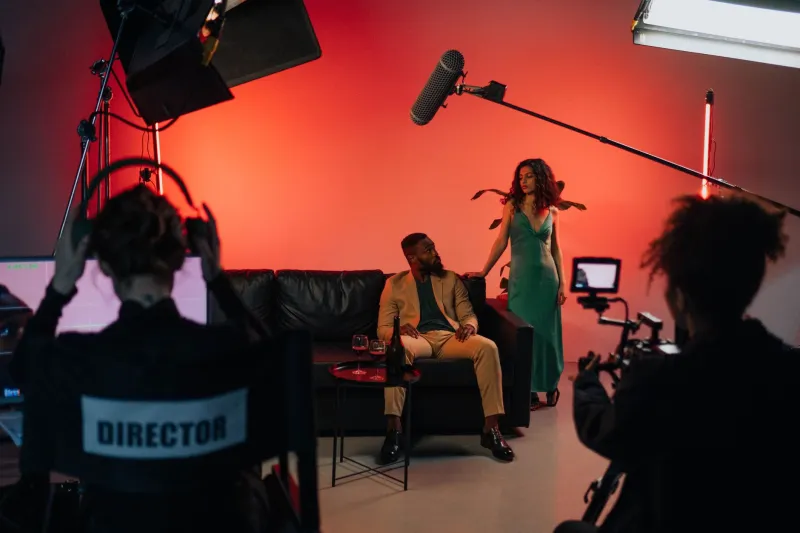
The crew is small: a commercial director who usually shoots skincare ads, a gaffer, a sound mixer, and a digital imaging technician who will later sign a nondisclosure agreement longer than the script. Two LED panels are bounced off a white foam board to soften the shadows under the eyes. An iPad running a teleprompter app is taped to a C-stand just off camera, angled so the client can read without looking away. A lavalier microphone is clipped under the collar, hidden by the hoodie's drawstring.
'Just talk to me,' the director says, which is the on-set equivalent of a magician saying 'watch closely.'
Rental Gear and the Illusion of Spontaneity
The rental invoice tells a more honest story. A two-light kit runs about $450 a day. The teleprompter package adds $125. The lavalier is $35. There is also a line item for 'texture props' — a half-finished mug of tea, a small plant, a cable-knit throw — because the background needs to look lived-in without looking staged.
The notes-app screenshot has its own production pipeline. A designer chooses the font size, the line breaks, and the exact shade of black. No emojis. No exclamation points. The timestamp should not land on a round number, because a round number looks scheduled. The cursor must not be visible. The text must fill just enough of the screen to feel unedited but not so much that it becomes a PowerPoint.
Sincerity, it turns out, has a props budget.
The Approval Chain Has Its Own Approval Chain
The first draft of the script contains the phrase 'I take full responsibility.' The lawyers replace it with 'I recognize the impact of my actions.' The studio asks for a line about 'the people I have let down.' A brand partner asks, gently, whether the word 'mistake' could become 'lapse in judgment.' The client's therapist suggests removing specifics. The client's spouse suggests adding a mention of family. The client suggests deleting the whole thing and moving to Montana.
What emerges is a document with seven authors and no fingerprints. The word 'sorry' appears three times, but never next to a named act. There is a beginning, a middle, and a future-tense ending. There is a promise to 'do the work,' which is a phrase that means everything and nothing, which is precisely why it survives the approval chain.
The Edit Passes: From Sobbing to Streamable
The first cut is too polished. It looks like a commercial for a bank that cares. The second cut is too raw; a tear arrives at the wrong moment and reads as a performance. The third cut adds a slight handheld wobble in post and a documentary-style crop. The color grade warms the skin tones and dials down the redness around the eyes. The sound mix lowers the room tone so the sniff at 1:42 reads clearly but not theatrically.
Captions are added. A thumbnail is debated, then abandoned. The video will post with a black frame and a simple title card. The final runtime is two minutes and forty-seven seconds, which is long enough to feel substantial and short enough to survive a TikTok stitch.
The Upload Is a Premiere
The video goes live at 8:05 p.m. Eastern on a Wednesday. That is after the East Coast news cycle has softened and before the West Coast sits down to dinner. A sentiment desk monitors the first thirty minutes. The caption is shorter than the video. A 'source close to' the client is already on the phone with two trade outlets. The comments are open, then limited, then open again.
By Thursday morning, the apology has been clipped, captioned, and remixed. The conversation has moved from what happened to how he said it. In Hollywood, that is not a distraction. That is the job.
Why the Machine Exists
Audiences say they want raw. Raw, unfortunately, tests poorly. The produced apology is not exactly hypocrisy; it is risk management with a ring light. The real tell is the call sheet. If sincerity had a call time, it would be 7 a.m., and craft services would be there by 6:30.
The most honest thing about the whole production is the rental agreement. It has a late fee, a damage waiver, and a signature line. The apology video has none of those things, which is how you know it was made by professionals.
Next week, the clip will be a meme, the client will be 'focusing on growth,' and the rental house will want its C-stand back. The apology did its job: it moved the story along. At Tinsel Twine, we will be here to untangle the next thread.